UX CASE STUDY
Green Quotient
A concept for a transparent carbon-credit marketplace — designed in response to the AVEVA EcoTech Emerge 2025 challenge on climate.
BRIEFAVEVA EcoTech Emerge 2025
TIMEFRAME3 Weeks
TEAMTeam of 3
MY ROLEResearch · Ideation · UI
The voluntary carbon market has a trust problem.
Companies need to offset emissions. Projects need funding. But the market that connects them is opaque, fragmented, and hard to trust.
OpacityBuyers struggle to verify whether credits represent real, additional carbon reductions.
FragmentationPPAs, surplus credits and green-tech investment all live in separate, disconnected places.
FrictionSmall green-tech projects with verified credits have no streamlined route to buyers.
ReportingESG reporting is retrofitted after the fact, rather than generated as a byproduct.
02 Who are the stakeholders?
Listing companiesRenewable-energy companies can list their PPAs or carbon credits for trade.
StartupsGreen-techs can raise funds by selling carbon credits when they're carbon-negative.
Buying companiesCarbon-deficit companies can buy offsets from the marketplace to meet targets.
Regulatory complianceMeeting regulatory requirements and reporting standards, verified in one place.
Scoped for three weeks — deliberately. We weren't going to redesign carbon markets; we focused on understanding and framing the real problem.
01Desk researchMapped the voluntary carbon market, its players and where trust breaks down.
02Expert interviewsSpoke to people close to carbon markets to pressure-test our assumptions.
03Concept & prototypeTranslated findings into a buyer/seller marketplace concept, built in Figma Make.
Three things shaped the concept.
01Verification is the bottleneck, not supplyCredits exist. Projects exist. What buyers lack is confidence that a given credit is real and additional.
02Buyers and sellers have asymmetric workflowsSellers think in projects and inventory. Buyers think in bids, portfolios and the reports they owe.
03ESG reporting is a job waiting to be bundledBuyers already need compliance reports — if the marketplace generates them, that's real, felt value.
What if a carbon marketplace treated verification and reporting as first-class citizens — not afterthoughts?
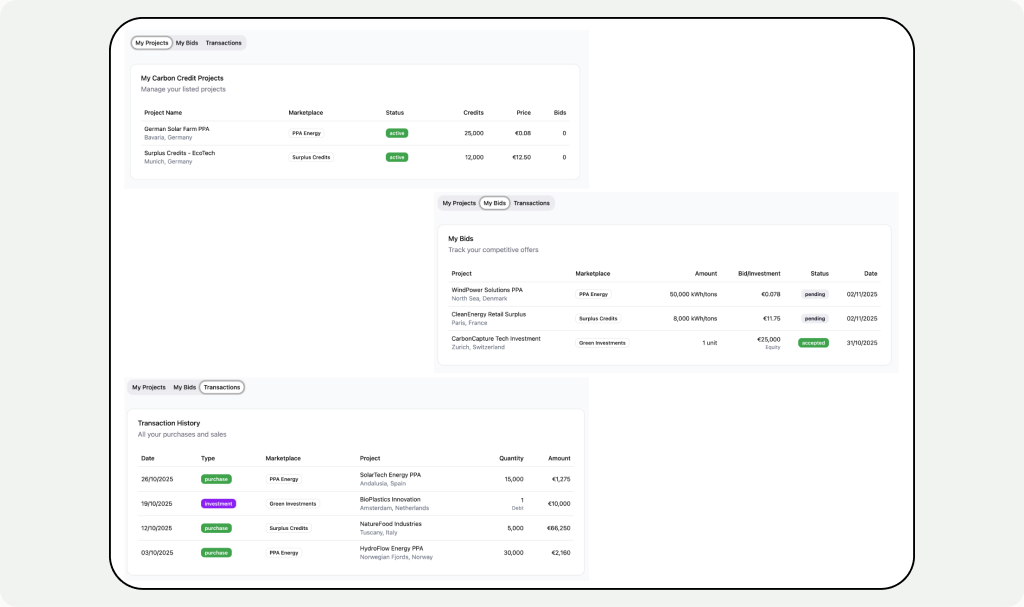
Sellers see projects, inventory, and the state of every bid — a workspace built around what they actually track.
Projects, bids & transactions as tabs · Status as the emotional anchor · A marketplace column on every row
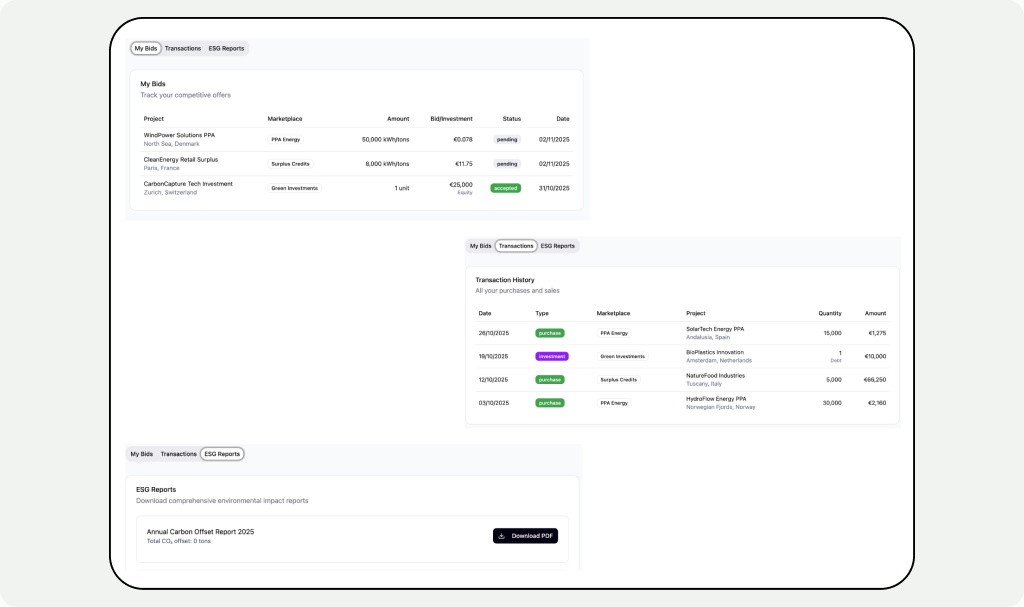
Buyers see bids, transactions, and the reports they already owe — closing the loop from purchase to compliance.
Bids → Transactions → ESG Reports · Investments shown alongside credits · Reports as a tab, not an export
08 Limitations & Next Steps
What this isn't — and what it would need to become real.
What this isn'tA production-ready product. It's a scoped three-week concept — the flows are real, but the backend and verification logic are not.
What it would takeReal verification partners, live credit data, and validation with actual buyers and sellers before anything ships.
What surprised usHow much of the carbon market's trust problem is a UX problem in disguise.
What we'd do differentlyFront-load the expert conversations and run more interviews — we did that a little late.
What this taught usAI prototyping isn't free speed. Holding a coherent design across prompts takes real intent.